
Marton Ilosfai

UX/UI Designer

Brand & Product Experience

Marton Ilosfai
Case Study 01 — From Brand History to a Shared Design Decision FrameworkTurning decades of organizational knowledge into principles that guide brand, UX and product decisions
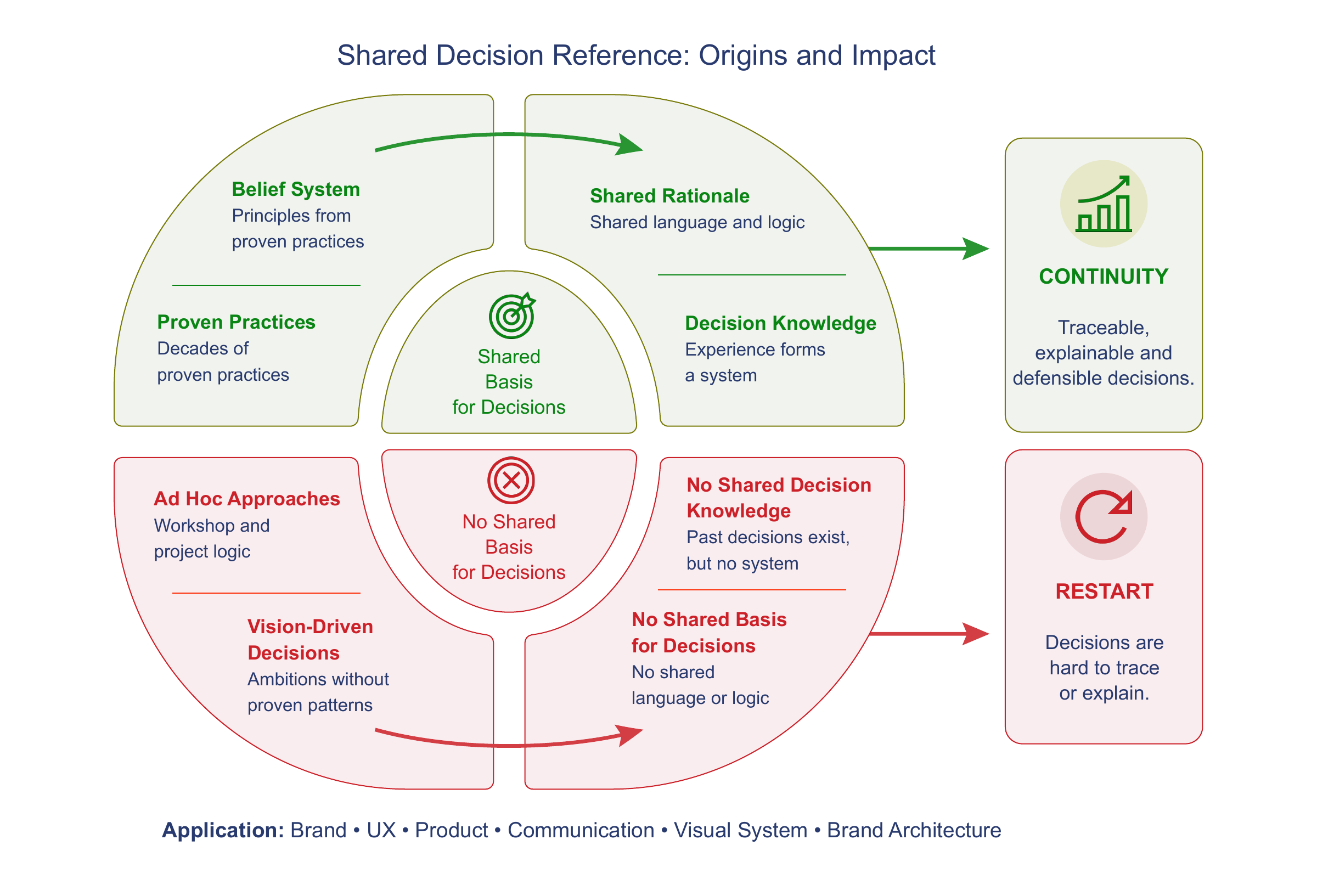
Shared Decision Reference: Origins and Impact. Proven practices developed over decades form principles, shared rationale and decision knowledge, supporting traceable, explainable and defensible decisions. Ad hoc and vision-driven approaches without a shared decision basis lead to decisions that are hard to trace or explain.

01 — Context

A Hungarian enterprise software company had decades of documented organizational history and a strong internal identity, but brand, UX, product and communication decisions did not always share a common reference point.

Decisions were being made, but the reasoning behind them was difficult to reuse. Similar questions could reopen because teams lacked a shared framework for explaining why one direction was more consistent with the brand than another.
02 — My role

As the company's first dedicated designer, I worked on turning fragmented organizational knowledge into a reusable decision framework.

Rather than inventing a new set of brand values, I analyzed existing evidence to identify recurring patterns in how the company had historically made successful decisions.

The source material included the company's documented history spanning several decades, incorporating leadership, employee, customer and partner perspectives.

03 — The challenge

The objective was not to define how every interface, message or visual asset should look.

The challenge was to create a layer above individual design decisions:

a shared set of principles that could help teams decide which directions were consistent with the brand — and which were not.

This distinction was important. The framework was designed to support decision-making without replacing the professional judgment of designers, product owners or developers.

04 — Approach

I reviewed the available organizational evidence and looked for recurring decision patterns rather than isolated statements.

The analysis moved through four layers:

Evidence → recurring patterns → Guiding Principles → decision criteria

From this work, I derived eight Guiding Principles covering areas such as managing complexity, customer-centered decision-making, long-term trust, responsible innovation and human expertise behind technology.

Each principle was then translated into a practical decision question.

Instead of saying what a design must look like, the framework identifies:

what a decision should support, what it should avoid, and what reasoning can be used to defend it.

The underlying methodology and evidence remained documented separately so that the framework could stay usable without losing traceability.

05 — Testing the framework on a real UX decision

To test whether the principles could work beyond abstract brand discussions, I applied them to an everyday product scenario:

A user imports invoice data and three rows contain errors. What message, interaction and visual response should the product provide?

One scenario. Two decision approaches.

A user imports invoice data. Three rows contain errors.

Without shared principlesGuided by the principle

Several responses could be justified:

  • Technically correct but unhelpful error message
  • Generic failure message
  • Overly alarming error state

No shared criterion for choosing between them.

Human Expertise Behind Technology

The design direction:

  • Identify the three affected rows
  • Explain the problem clearly
  • Show the correct format
  • Preserve imported data
  • Allow correction without restarting

The principle does not prescribe the exact layout, color or component.

It creates a defensible direction within which the actual UX and visual design can happen.

06 — Outcome

The eight Guiding Principles were adopted as the company's shared decision reference for subsequent brand, UX, product and communication decisions.

They also became the foundation of the company's Brand Book, which was subsequently approved by leadership and distributed company-wide.

07 — What this project demonstrates

Problem framing → evidence synthesis → design principles → decision framework → practical UX application → organizational adoption

The output was not another set of brand statements.

It was a reusable system for making design decisions more consistent, explainable and defensible.

Case Study 02 — Designing a Brand Architecture for a Multi-Product PortfolioTurning fragmented product identities into a scalable decision system
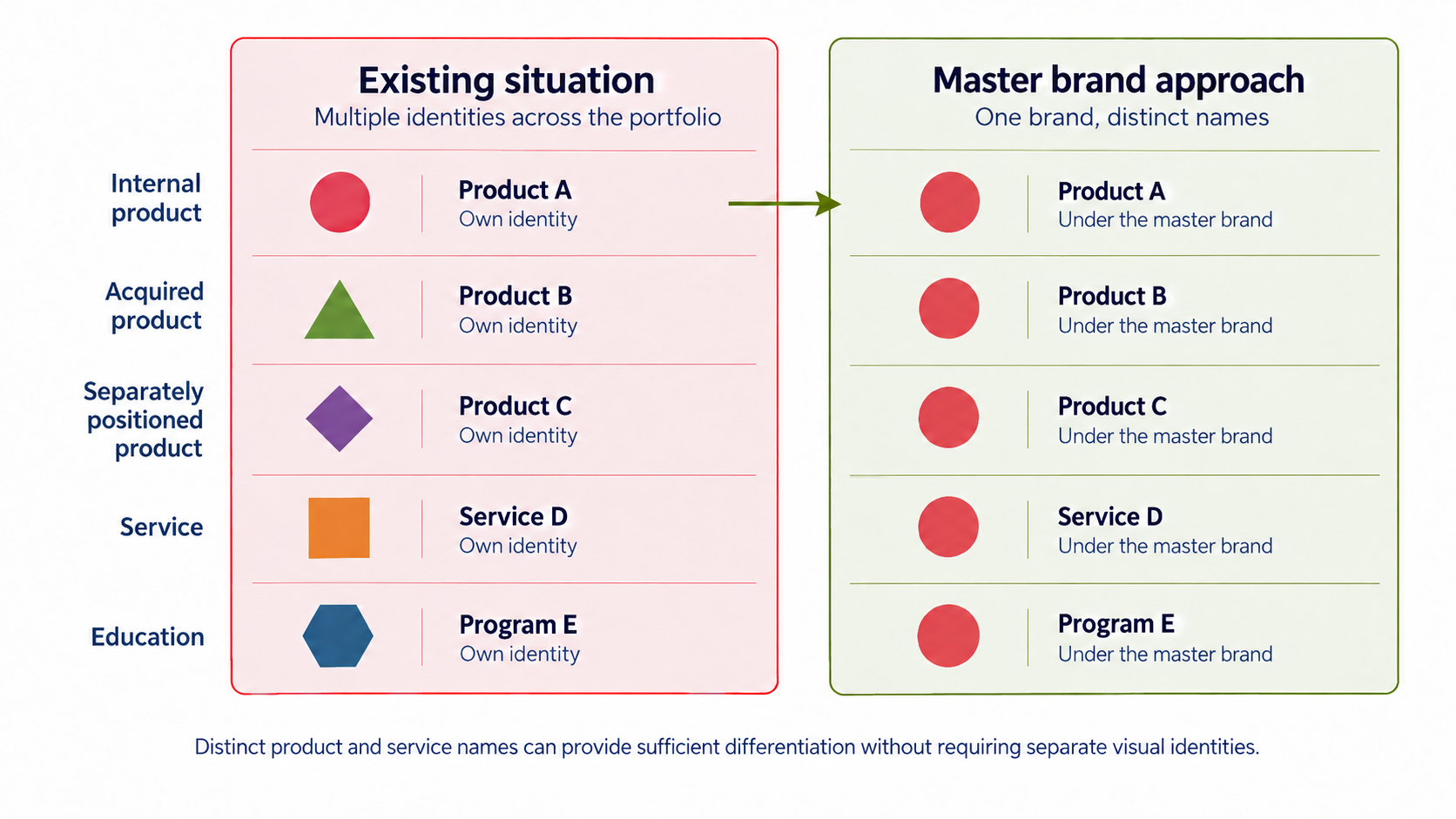
Comparison of multiple identities across the portfolio with a master brand approach: Product A, Product B, Product C, Service D and Program E retain distinct names under one shared brand identity.
From fragmented product identities to a shared Master Brand architecture.

01 — Context

A Hungarian enterprise software company operates a portfolio of products and services with different histories, levels of recognition and existing identities.

Without a shared brand architecture, decisions about product naming, identity, logo use and brand investment risk becoming individual exceptions rather than parts of a coherent system.

The challenge was therefore not simply:

What should each product look like?

It was:

What rule should determine how products relate to the company brand — and when is breaking that rule justified?

02 — My role

I developed a portfolio-level brand architecture framework that could be used as a common starting point for future product and brand decisions.

Rather than treating each product identity separately, I approached the portfolio as a system.

The objective was to create:

a default architecture, explicit exception criteria, and a repeatable method for evaluating individual products.

03 — Exploring the architecture

I evaluated three possible models:

Brand architecture alternatives
Master BrandProducts primarily build on the company identity and shared design system.
Endorsed BrandProducts retain more individual identity while visibly connecting to the company.
House of BrandsProducts operate as substantially independent brands.

The analysis considered not only visual identity, but also the consequences of each model for existing brand equity, communication, maintenance and future investment.

External brand-architecture research and cases such as the SAP/Emarsys integration were used as supporting evidence rather than as templates to copy.

04 — The decision framework

The analysis led to one central rule:

Master Brand should be the default portfolio architecture.

But the important part was not simply choosing Master Brand.

I defined the exception logic around it.

Moving away from the default requires a defensible business, market or organizational reason, together with the capacity to maintain and communicate a separate identity.

This changed the question from:

“Which identity do we prefer for this product?”

to:

“Is there enough business value to justify creating and maintaining an exception?”

05 — Turning the model into a product-level decision tool

I then applied the framework across the existing portfolio.

Products were mapped against the default architecture and exception criteria, creating different paths depending on their context.

For example:

  • some products fit directly into the Master Brand;
  • existing recognition could justify temporary Endorsed Brand treatment;
  • independent branding required stronger evidence and sustainable support;
  • transitional identities could eventually move toward full Master Brand integration.

This transformed brand architecture from an abstract model into a repeatable classification and decision system.

06 — Applying it to the flagship product

The clearest test was the company's flagship AI product.

The decision was whether to position the flagship AI product as an independent brand or build on the company's existing brand equity.

The framework compared three routes:

Framework comparison
Master Brandshared trust, shared design system, lowest additional brand investment
Endorsed Brandpartial independence with greater communication and coordination requirements
House of Brandsseparate identity, separate rules and significantly greater maintenance requirements.

The resulting recommendation was:

The company's flagship AI product should follow the Master Brand architecture.

07 — Outcome

The brand architecture framework was adopted as a shared starting point for subsequent product and brand decisions.

Its Master Brand default-and-exception logic was incorporated into the Brand Book, which was approved by the CEO and distributed company-wide.

The approved Brand Book also documented a Master Brand direction for the company's flagship AI product.

08 — What this project demonstrates

Portfolio problem → architecture alternatives → decision criteria → default rule → exception logic → product application → organizational adoption

The result was not simply a logo hierarchy.

It was a scalable system for deciding how products should relate to the company brand — and when an exception is worth the cost and complexity.